
Repetitive lifting, inefficient movement between workstations and production bottlenecks can make material handling slower and more physically demanding than it needs to be. When reviewing an overhead material handling system, one of the first questions is whether the process is better suited to a crane, a conveyor or a combination of both. The answer starts with how the load needs to move. If materials need flexible lifting and positioning around a working area, an overhead crane may be the better starting point. If products repeatedly follow a defined route between production stages, an overhead conveyor may be more appropriate.
At NIKO, we supply both crane systems and conveyor systems, so we start with the load, movement and production process rather than assuming one type of equipment is right for every application.
| Requirement | Crane | Conveyor |
|---|---|---|
| Flexible movement within a working area | Well suited | Application dependent |
| Follows track layout | Application dependent | Well suited |
| Controlled lifting and positioning | Well suited | Not its primary role |
| Repeated movement along a defined route | Application dependent | Well suited |
| Keeping floor space clear | Yes | Yes |
| Manual and powered options | Available | Available |
What Is the Difference Between an Overhead Crane and an Overhead Conveyor?
An overhead crane lifts, moves and positions a load within a working area. Depending on the configuration, it allows the operator to move the load in more than one direction and position it where required. An overhead conveyor moves materials or components along a defined track, making it particularly suitable where products repeatedly travel between workstations or production stages. A simple way to decide where to start is to consider the movement required. If the priority is flexible lifting and controlled positioning, we would consider a crane. If the priority is repeatable movement along a defined route, a conveyor may be more appropriate.
When Is an Overhead Crane System the Better Choice?
We typically consider an overhead crane when operators need to lift and position loads at different points within a workstation, production area or workshop. Our light cranes and monorails can handle loads up to 2,000 kg and are available with manual or electric lifting and travel options. For applications requiring higher lifting capacities or larger working areas, our overhead travelling cranes provide another option.
A crane may be suitable where:
- Loads need to move in more than one direction
- Controlled positioning is important
- Several workstations need to be served
- Operators regularly lift or reposition components
- Floor space needs to remain clear
A correctly specified crane can also reduce the physical effort involved in repetitive lifting and positioning tasks.
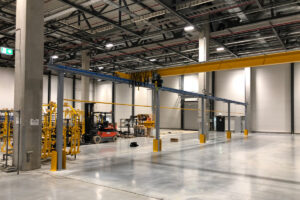
When Is an Overhead Conveyor System the Better Choice?
We typically consider an overhead conveyor when materials repeatedly follow a defined path through production. Our manual conveyor systems can accommodate loads up to 2,000 kg and are used for applications including material transportation, assembly, storage and painting.
A conveyor may be suitable where:
- Products repeatedly travel between the same processes
- The production sequence follows a defined route
- Components pass through painting, finishing or processing areas
- Floor space needs to remain available
- Parts of the system may require powered movement
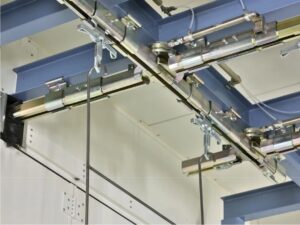
Our conveyor systems can incorporate different track layouts, switches and turntables, while specific sections or complete systems can also be powered where required.
Can Cranes and Conveyors Work Together?
Yes. In many production environments, the choice is not simply crane vs conveyor. A crane can lift and position a component onto a conveyor, which then moves it through the production process before another lifting system handles unloading or final positioning. Our light cranes can connect with other cranes and conveyors, allowing different handling methods to form part of the same process. We also use both technologies within our own Southam production facility. The important point is to choose the handling method that best suits each stage rather than expecting one type of equipment to perform every task.
What Should You Consider Before Choosing a Crane or Conveyor?
When we assess an application, we look at several practical factors:
- Load: What are the weight, dimensions and shape of the materials being moved?
- Movement: Does the load need flexible positioning or follow a defined route?
- Frequency: How often does the movement take place?
- Positioning: How accurately does the load need to be placed?
- Space: What floor space, headroom and building structure are available?
- Future requirements: Could production volumes, layouts or automation requirements change?
Looking at these factors together helps us determine whether a crane, conveyor or combined solution is the most appropriate starting point.
Choosing the Right NIKO Material Handling Solution
At NIKO, we start with what needs to be moved, where it needs to go and how the process works. Where loads need flexible lifting and controlled positioning, we would typically consider a crane. Where products repeatedly follow a defined production route, a conveyor may be more appropriate. Where the process requires both, we can consider an integrated system. If you are planning a new material handling system or reviewing an existing process, send us your load weight and dimensions, movement path and an outline of what you want to improve.
Discuss your material handling application with us
Frequently Asked Questions
What Is the Main Difference Between an Overhead Crane and an Overhead Conveyor?
A crane provides flexible lifting and positioning within a working area, while a conveyor moves materials along a defined track.
When Should You Use a Crane Instead of a Conveyor?
We would consider a crane where loads need to move in different directions or require controlled positioning at several points.
When Is an Overhead Conveyor the Better Choice?
A conveyor may be more appropriate where products repeatedly move along the same defined route between production stages.
Can a Crane and Conveyor Be Used Together?
Yes. We can combine them where different stages of the process require different types of movement.
What Information Do You Need to Specify a Material Handling System?
We typically need to understand the load weight and dimensions, movement path, handling frequency, positioning requirements, available space and production process.
Can Cranes and Conveyors Help Reduce Manual Handling?
Yes. Both can provide mechanical support for lifting or moving materials, although the most suitable solution depends on the application.